It is the first question almost every founder or product lead asks us, and the only honest one-line answer is "it depends." That answer is useless on its own, so this post turns it into a framework you can actually plan around.
The short version: the cost of an AI MVP is decided far more by scope and integration than by anything to do with the model. Teams that go over budget are almost never under-funded. They are over-scoped.
The four cost drivers
In rough order of impact, four things decide the budget.
- Scope. The single largest lever. One well-chosen feature that proves the core idea costs a fraction of a "platform." Every additional must-have multiplies the surface area you have to design, build, test, and maintain.
- Integration. Talking to your existing systems (authentication, data stores, billing, a legacy API) is where the real time tends to go. The model call is a few lines. Wiring it into a running business is not. Refining it into a non-hallucinating product with guardrails is not.
- Data. Clean, accessible data is cheap to build on. Messy or siloed data is where weeks quietly disappear, especially when retrieval (RAG) is involved.
- Stakes. Anything touching regulated data (health, finance, anything with a compliance story) raises the bar on testing, review, and guardrails, for good reason.
Notice what is not on that list: which model you use. Swapping between frontier models is usually a configuration change. The expensive work is everything around the model.
A simple way to picture it
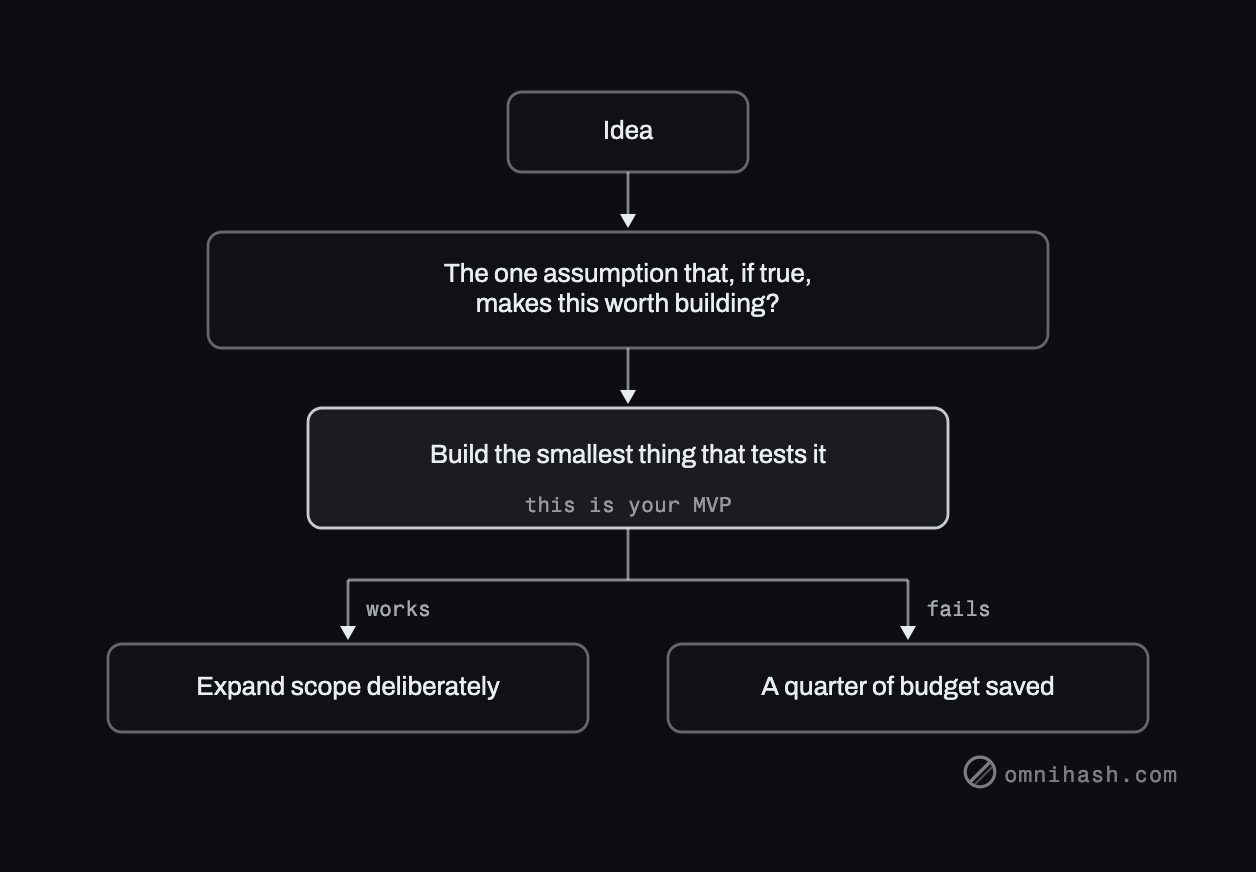 Figure 1. Scope-first sequencing. The MVP exists to test the riskiest assumption, not to be a small version of the final product.
What a realistic range looks like
We will not pin a single number to a blog post, because scope decides it. What is stable is the shape of the estimate.
| Build type | Typical scope | Relative cost | Typical timeline |
|---|---|---|---|
| Focused proof | One feature, one integration, clean data | Lowest | Days to ~2 weeks |
| Real product MVP | Several features, real integrations, real users | Medium | A few weeks |
| Regulated platform | Multiple features, compliance, audited data paths | Highest | Over a month |
The useful move is to identify the smallest version that proves the riskiest assumption, price that, and sequence everything else behind it. As one data point: we once took a production-grade AI agent platform from zero to live in a single month, after a previous team had spent eight months and shipped nothing. The difference was not typing speed. It was ruthless scoping and fast decisions.
How to keep it lean without making it cheap
- Cut scope to one assumption. If it is true, does the product become worth building? Build that and nothing else first.
- Validate with real users early. A prototype that survives contact with users is worth more than a polished plan.
- Do not gold-plate the model layer. Start with a strong general model. Optimize only where measured data says to.
- Reuse boring infrastructure. Use modern tools where they earn their keep and dull, dependable ones everywhere else.
The cheapest AI MVP is the one you scoped correctly. Money spent narrowing the question buys back far more than money spent widening the build.
Engagement models
Most of our work is either project-based (a scoped build with a clear deliverable) or a monthly retainer (ongoing development and iteration). Advisory work, such as architecture reviews, build-versus-buy decisions, and AI readiness, is usually fixed-scope or retainer. In every case you get a clear estimate after a short scoping conversation, not a surprise at the end.
If you are trying to budget an AI build, the fastest path to a real number is to tell us the single outcome you are chasing. We will tell you the smallest version that gets there.