A single capable agent with good tools will outperform an elaborate multi-agent system on most tasks you actually have. We are saying this up front because the industry momentum runs the other way: every framework now ships a way to spawn swarms of cooperating agents, and the demos are seductive. But adding agents is adding distributed systems, and distributed systems do not get simpler when the nodes are non-deterministic.
So the real question is not "how do I orchestrate agents" but "does this task earn a second agent at all." Most do not. The ones that do tend to share a shape, and there is a pattern that fits that shape well.
Single agent versus many
A single-agent system is a loop: one model, one context window, one tool belt, running until the task is done. It is easy to reason about because everything that happened is sitting in one transcript. When it goes wrong, you can read the whole story in one place.
A multi-agent system introduces a coordinator and several sub-agents, each with its own context and often its own specialization. It buys you parallelism and separation of concerns at the cost of coordination. That trade is sometimes worth it and usually is not.
| Dimension | Single agent | Multi-agent (orchestrator-worker) |
|---|---|---|
| Best for | Linear, well-scoped tasks | Broad tasks that split into independent parts |
| Context | One shared window | Isolated per agent |
| Parallelism | None, it is sequential | Real, workers run at once |
| Latency | Lower, no hand-off overhead | Higher per step, but parallel work can win wall-clock |
| Token cost | Lowest | Multiplied by the number of agents |
| Debuggability | One transcript to read | Many transcripts plus the hand-offs between them |
| Failure surface | Small and legible | Large: every hand-off is a new seam |
Read that table as a bias toward the left column. You move right only when a specific property in the right column is the thing you need.
The orchestrator-worker pattern
When a task genuinely splits, the pattern that holds up is delegation, not a free-for-all of peers chatting. One orchestrator owns the goal. It decomposes the work, spawns specialized sub-agents, hands each a narrow brief, and then synthesizes their returns into one answer. The workers do not talk to each other. They talk to the orchestrator, and only the orchestrator sees the whole picture.
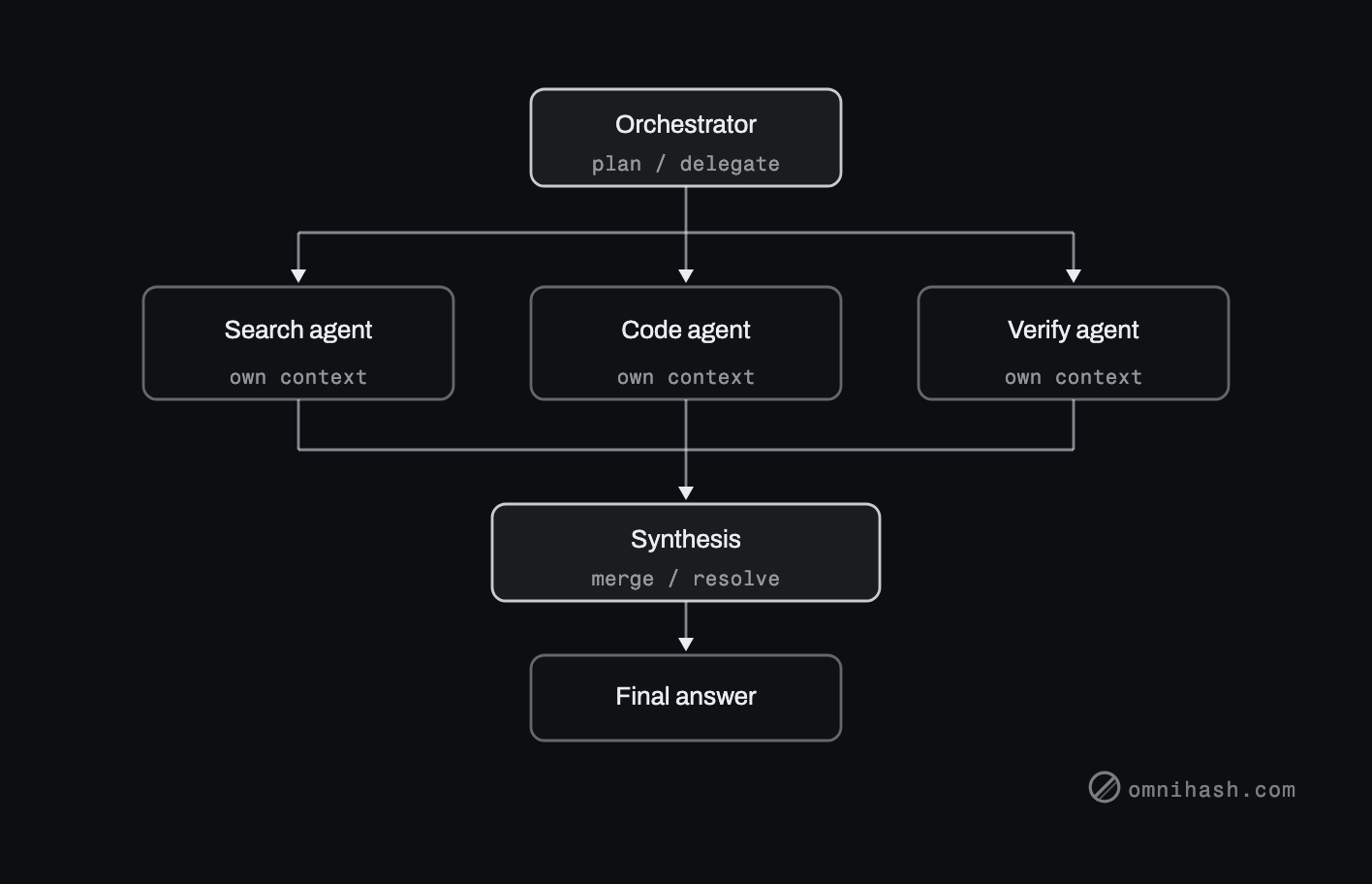 Figure 1. The orchestrator-worker pattern. A coordinator fans work out to specialized sub-agents running in isolated contexts, then fans their results back into a single synthesis step.
The canonical example is research. A question like "compare how five vendors handle data residency" decomposes cleanly: one worker per vendor, each digging in parallel, the orchestrator merging findings and resolving contradictions. Each sub-agent gets a clean, focused context. None of them drowns in the other four vendors' material.
Three properties make a task a good fit:
- The subtasks are independent. If worker B needs worker A's output to start, you do not have parallelism, you have a sequence wearing a costume. Just use one agent.
- The work is wider than one context window comfortably holds. Splitting lets each agent stay focused on a fraction of the material.
- Synthesis is cheaper than the gathering. The orchestrator should spend most of its budget merging, not redoing the workers' jobs.
Why context isolation helps
The strongest argument for multiple agents is not parallelism, it is context isolation. A single agent grinding through a large, messy task accumulates everything in one window: dead ends, half-read documents, tool output it no longer needs. That clutter degrades the model's attention and quietly raises the odds it confuses one thread for another.
Give each sub-agent its own window and the picture changes. The search agent sees only what it needs to search. The verifier sees only the claims it must check. Each one reasons over a small, relevant slice instead of a large, contaminated one. The orchestrator receives compressed results, a paragraph of findings rather than the raw transcript, which keeps its own context clean for the part that actually needs the whole picture: synthesis.
This is the same instinct as keeping functions small and giving each a single responsibility. Isolation is a feature, not just a side effect of running separate processes.
The coordination cost is real
None of this is free, and the costs are easy to underestimate because they do not show up in the happy-path demo.
Tokens multiply. Five workers plus an orchestrator can burn an order of magnitude more tokens than one agent doing the task linearly. Each agent re-establishes its own context. For a task that did not need splitting, you paid five times over for the privilege of a worse answer.
Latency does not always improve. Parallel workers can win on wall-clock time, but you pay for the orchestrator to plan, for the hand-offs, and for a synthesis pass that cannot start until the slowest worker returns. On a task that was naturally sequential, you have added round trips and gained nothing.
Complexity moves into the seams. Every hand-off is an interface, and interfaces between non-deterministic components are where the hard bugs live. You now own prompt contracts, result formats, timeouts, and a synthesis step that has to reconcile disagreeing workers.
The failure modes
Multi-agent systems fail in characteristic ways, and knowing them in advance is most of the defense.
- Cascading errors. A worker returns a confident, wrong result. The orchestrator has no easy way to know it is wrong, folds it into the synthesis, and the error propagates downstream wearing the authority of a finished answer.
- Lost context across hand-offs. The orchestrator briefs a worker, but the brief is lossy. The worker fills the gap with assumptions, answers a subtly different question, and nobody notices because the brief and the answer were never in the same window.
- Runaway loops. An orchestrator that can spawn agents, given an ambiguous goal, will spawn agents. Without hard caps on depth, breadth, and total spend, a vague task becomes a recursive budget fire.
- Duplicated work. Two workers, handed overlapping briefs, fetch the same sources and reach the same conclusion. You paid twice for one finding, and the orchestrator now has to dedupe what it should never have forked.
The mitigations are unglamorous and mandatory: strict budgets per branch, structured result formats so the orchestrator can sanity-check returns, a verification step before synthesis treats a claim as true, and crisp non-overlapping briefs.
When not to do this
This is the part most write-ups skip. Do not reach for multiple agents when:
- The task is linear. If step two depends on step one, one agent is faster, cheaper, and easier to debug.
- The task is small. The orchestration overhead dwarfs the work. A single agent with the right tools finishes before the coordinator has finished planning.
- You cannot define clean briefs. If you cannot describe each sub-agent's job in a sentence, the hand-offs will leak, and the system will fail in the lossy ways above.
- You have not yet maxed out a single agent. Better tools, a tighter prompt, and retrieval solve more problems than orchestration does, at a fraction of the cost and complexity. This is the same lesson as shipping RAG to production: fix retrieval and prompting before you add machinery.
Multiple agents are a scaling tool, not a default architecture. Reach for them when one well-equipped agent has genuinely run out of room, and not one task sooner.
The honest default is one agent, good tools, a clean prompt, and an eval set to tell you when it is actually falling short. When the work is broad, parallel, and independent enough to justify the coordination tax, the orchestrator-worker pattern is the right way to spend it. Most of the time, it is not, and the discipline is recognizing which case you are in.
At Omnihash we build agentic systems for startups and enterprises, and a fair amount of that work is talking teams out of orchestration they do not need yet. If you are weighing single agent against many for a real product, we are happy to look at the specific task and tell you which one it earns.